Thinking About Photography
Dedicated to expanding our ideas about photography
Photography and Our Environment
April 10th - June 30th
Spring 2025

William McFarlane Notman, Yoho National Park, British Columbia, 1887,
© The Trustees of the British Museum. CC BY-NC-SA 4.0
"The earth has music for those who listen." - unknown
When I was in my late 20s, I became interested in moving from still photography into film-making and had volunteered to be the Art Director on a student film. This is where you create the look and style of a film through locations, lighting, costumes and props. It was set in the desert and we would be spending several weeks out at 29 Palms, California (in the Mojave Desert). At that time, to be honest, I wasn’t really a fan of the desert - it was something you drove through. Its very name meant empty.
So we headed out - keep in mind that working on a film crew is a lot of “hurry up and wait.” There’s endless time sitting and waiting: for the equipment to be set up, for the light to be perfect - waiting while they reshoot because a plane flew overhead during the take. We’d scurry in to reset the props for another take and then move back out to wait. It was during those waiting times, sitting silently and looking out at the desert, that it slowly unfolded itself to me, changing from empty space into a magical, harsh landscape filled with subtle moments of beauty and disarming vistas.
That transformation has stuck with me - in fact those open spaces remind me of the ocean - providing us with an opportunity to feel small, to be dwarfed by something much greater than us. Our largest mistakes - the path to ruin - is when we forget that we are small in comparison to nature. We are at once both a speck in the universe and at one with it. These natural spaces form our origin stories and our soul responds in profound ways when we are surrounded by it. Think about what happens when you arrive at the ocean - almost against your will, your eyes gaze out towards the horizon as your soul becomes quiet. Richard Misrach's Desert Cantos project is a perfect example of this captivating experience.
We are not the owners of this world, we are the custodians. They have been lent to us and we hold them in trust for tomorrow. From photography's inception, it has been a champion for our lands. In the midst of our brutal civil war, and inspired by Carlton Watkins' mammoth-plate photography, President Lincoln signed the Yosemite Valley Grant Act of 1864 - which laid the foundation for our National Parks Service. From Sebastião Salgado we have Genesis, his eight-year worldwide survey which he calls "my love letter to the planet" featuring landscapes and people unchanged by modern development. One of my personal favorites is Michael Kenna - his elegant compositions and tonal range create quiet moments in the landscape and a sense of timelessness.
The theme for this showcase is very dear to me and I’m so pleased with the wonderful group of featured artists and book reviews. One photographer blends insights on mental health with a passion for visual storytelling, while another turns the lens toward our inland seas - examining the fragility and resilience of complex ecosystems. Several have found photography is a passport - exploring the many vistas that people around the world call home. Whether they journey to the world’s last truly wild places - or the wild spaces found outside their door, all these projects celebrate and honor our natural environments. From PhotoBook Journal we have an exceptional set of books on: life in the Russian Arctic, climate change, our wild seas, animals, the melancholy of everyday landscapes and creativity inspired by our natural spaces.
Donna Bassin

©Donna Bassin

©Donna Bassin

©Donna Bassin

©Donna Bassin

©Donna Bassin

©Donna Bassin
© Donna Bassin, all rights reserved
Environmental Melancholia: Precarious Places
Environmental Melancholia explores the nuanced interplay of injury, damage, loss, grief, resilience, and repair rooted in personal and collective experiences. This series confronts the urgent complexities of the climate crisis and its profound effects on our environment, physical survival, and psychological well-being. As a clinical psychologist specializing in traumatic loss, I have blended my insights from mental health with my passion for visual storytelling, creating 45 photo-based landscapes that reflect the deep losses we are experiencing in terms of land, flora, and fauna as we witness contemporary ecological challenges and the vulnerability of our planet. My work is deeply personal and rooted in my grief as I observe this environmental decline. I aim to create aesthetic experiences that engage and provoke thought; I invite viewers to face their existential fears, encouraging collective connection and reflection instead of denial or paralysis.
Visually, I draw inspiration from the captivating landscapes of 19th-century American painters of the Hudson River School, such as Thomas Cole and Frederick Edwin Church. Their vision of a fictive, unspoiled wilderness that melds reality and imagination often relies on composite scenes from various views and inspires my reinterpretations. While they celebrated the beauty of nature as an early call for environmental preservation amid the unchecked industrial age of Manifest Destiny, their work also reflects the shadow of history, erasing Indigenous peoples and the exploitation of their land.
Similarly, at first glance, many of my landscapes seem idyllic and recognizable; however, a closer look disrupts this façade, challenging assumptions about an unchanging natural world and our expectation that nature will persist unchanged. Each piece reshapes traditional topographies, prompting questions about the changes happening in our current landscapes. To create my imagined landscapes, I layer two photographs – one printed on Moab Entrada Rag Natural and the other on Moab Moenkopi Unryu, sourcing each from my archives of distinct geographic locations to form a single, unified landscape. Each landscape features GPS coordinates from the original locations, intentionally omitting human-defined borders and nations’ names. I juxtapose visions: one depicting desolation – deforested mountains, melting glaciers, or parched coasts, with another that is vital, reflecting the beauty of what has been lost or what could be reclaimed through collective action. Through digital editing, I harmonize the two layers, aligning color, scale, or composition – a mountain’s curves connect to a river’s path – initiating a dialogue between hope and despair, healing and loss. I attach these layers using archival photo corners, Japanese washi tape, or embroidery thread, adding a tactile dimension to the work.
In some works, the photo corners evoke nostalgia, hinting at a future where remnants of our natural world exist only as distant memories, reminiscent of postcards in a scrapbook of a vanishing past: a sentimental archiving of loss. In others, I grapple with the swift disappearance of our resources; fertile landscapes and wildlife are extracted from one photograph and transferred to another of a diminished, injured environment, tenuously held together with tape or stitching to embody a reparative process of healing and restoration.
As an artist, I wrestle with the implications of categorizing my work as political. While I aim to address pressing issues, such labeling might constrain my work to a singular narrative and overlook its emotional, aesthetic, and conceptual layers. The complexity of social and environmental challenges often defies simplistic categorization, and I hope my series serves as a medium for nuanced exploration rather than a prescriptive call to action. I understand that political labels can alienate specific audiences, limiting the reach and resonance of my art. As I navigate these tensions, I remain committed to creating art that invites reflection and dialogue, transcending the binary definitions of art and politics.
Lori Kella

©Lori Kella

©Lori Kella
©Lori Kella

©Lori Kella

©Lori Kella
©Lori Kella, all rights reserved
Shifting Ground
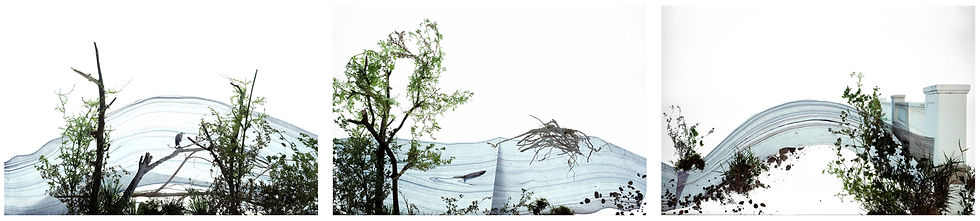
As a native of the Great Lakes, I have turned my gaze toward our inland seas, examining the fragility and resilience of this complex ecosystem. Shifting Ground focuses on the dramatic coastal erosion that has intensified as protections for the shoreline vanish. To begin the project, I created an 8-foot-long diorama using paper, wood, paint, and tiny weeds that I could sculpt into miniature trees. Next, I added artificial lighting and backdrops in order to photograph the construction in my studio.
The resulting photograph, Eroding Shoreline: The Calm Before the Storm, is a poetic reduction of this complex terrain, a still in the unfolding saga of the lakefront. Over the subsequent months I photographed this facsimile in different ways, first by capturing its contours and silhouettes, then by deconstructing the model itself. Toward the end of the project I was furiously pulling apart modeled landmasses, balconies, and canopies and arranging them on a large lightbox to photograph. I arranged these elements to mimic the actual terrain, but also to convey the impermanence of the hillside.
Tearing apart the paper shoreline became a metaphor for the hillside’s physical destruction as well as my inability to halt everything that seemed to be collapsing around me. The photographs and the process are a nod to the ferocious power of nature. The deconstructed landscapes shift into strange maps articulating natural forces and tracing the contours of fragile terrain and man-made structures alike. The photographs become unmoored as the viewpoint flips from frontal to aerial perspective and landmasses float free from the water, whose forces they indirectly reference in their disintegration.
In companion with these deconstructed hillsides are melodic images tracing the flow of Euclid Creek, a small tributary that is part of a decade long renewal project. This ecosystem, dotted with herons, beavers, and native plants, shows a thriving pocket of wildness intermixed with urban architecture. Together these images hint at multiple futures, for neither are straightforward depictions of the landscape, rather they are imaginings that represent my hopes and fears for the small stretch of land I inhabit.
Kerik Kouklis

©Kerik Kouklis

©Kerik Kouklis

©Kerik Kouklis

©Kerik Kouklis

©Kerik Kouklis

©Kerik Kouklis
©Kerik Kouklis, all rights reserved
Earth is Home: A World of Photographs
Home is something that I’ve been thinking a lot about the past few years. After 30 years in our last home, in 2020 we pulled up stakes and moved 350 miles from the Sierra Foothills to California’s Central Coast, two miles from the ocean. We moved from the hot summers and cold winters of the foothills to the moderate climate of the Central Coast where it’s never too hot or too cold and where wildfires are rare. Although at first everything was unfamiliar, at the same time I knew we had made the right choice. From the beginning, it felt like home even though I didn’t know where the grocery store was or where to find the best cappuccino. Those things came with time. But the feeling of being home was there from the start.
I’ve had similar experiences in my travels over the last ten years since I left the corporate world and have spent a lot of time exploring. Some places I’ve been to repeatedly (eight times to Iceland and three times to Mongolia and countless times to Yosemite) others only once (Japan, Brazil, the Galapagos, Norway, Germany). But all these places represent Home to me in their own ways. Travel has greatly enriched my life and my understanding of the people who share the planet with us. I am often humbled by how their life experience differs from mine. Imagine being a Mongolian nomad living on the steppe where winter temperatures easily get to minus 40 and worse when it’s windy. I’ve had a small taste of that. I also stood in the middle of the Gobi Desert on a summer night when there was nothing but starlight and the light from our campfire. That was the first time I experienced 180 degrees of stars from horizon to horizon. On several occasions, I have also stood in awe of mother nature watching the aurora borealis dance across the skies in Iceland. Also in Iceland, I witnessed the rare stranding of a pod of pilot whales. We were helpless and could only bear witness to one of Nature’s heart-breaking realities as the whales were in their death throes. I crave experiences like these and attempt to capture them to the best of my abilities as photographs and short films. My dad built me my first darkroom when I was 12. In 2020 I built what I expect to be my last darkroom 50 years later. It happens to be located just a few miles from where the likes of Edward Weston and Ansel Adams made beautiful iconic photographs at the Oceano Dunes.
Lynn Alleva Lilley

©Lynn Alleva Lilley

©Lynn Alleva Lilley

©Lynn Alleva Lilley

©Lynn Alleva Lilley

©Lynn Alleva Lilley
© Lynn Alleva Lilley
© Lynn Alleva Lilley, all rights reserved
The Nest
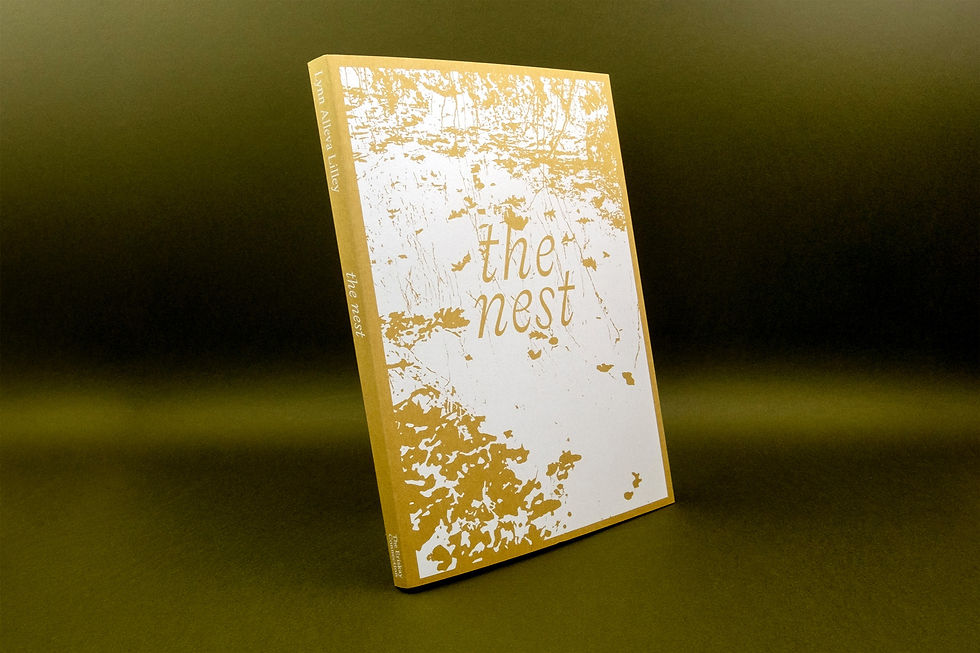
Seven years ago I walked into the woods of Sligo Creek park across the street from our home in Silver Spring, Maryland. Immediately, I was struck by how the bright winter light fell on the brambles creating masses of shimmering silver and red lines. These lines in nature felt like possibility, a way to weave a life from fragility, upheaval and chaos and into a healing beauty. Evidence of presence and transience continues to surprise and I'm left again with questions.
Beth Moon

©Beth Moon

©Beth Moon

©Beth Moon

©Beth Moon

©Beth Moon

©Beth Moon
© Beth Moon, all rights reserved
Island of the Dragon's Blood
There are few places left on earth so remote and untouched by time. Socotra is one of the world’s last truly wild places with a uniquely diverse and enchanting landscape of surreal beauty. Rich in mythical history, Herodotus wrote of the immortal phoenix that came to this island to be reborn in a nest of cinnabar and incense every 1,000 years. Frankincense that burned in the temples of ancient Greece and Egypt was harvested from this island. Glimpsing the dragon’s blood trees that mantle the Haghier Mountains, one imagines this is what the world must have looked like millions of years ago.
Situated in the Arabian Sea off the horn of Africa, ruled by Yemen, the island of Socotra is home to over 700 native plants and animals found no where else on the earth. Cut off from the rest of the world due to hazardous travel and relentless monsoon winds, the island now has flights from the main land.
Most astonishing are the trees! Living up to 500 years, the mythical dragon’s blood tree with vertical trunk and arching canopy could easily be imagined as an umbrella blown in side out. When the trunk is cut, a scarlet colored resin oozes from the tree prized for it’s celebrated medicinal qualities. Sap from the tree was sought by Roman Gladiators to cure wounds. Once a vast forest, these remaining trees, unique to Socotra are now classified as endangered. Recent years have shown a troubling decline due to over grazing and insufficient cloud cover needed for young saplings.
Smelling the sweet and very valuable amber resin that oozes from the frankincense tree one can easily imagine why it has been traded for over 5,000 years. The Christmas story tells of the gift of frankincense to the Christ child which is the inspiration for gift giving today. Recent studies reveal this aromatic resin relieves depression and anxiety. With a wide variety of uses from spiritual to medicinal used in religious ceremonies, it was thought the smoke would take prayers to heaven. Socotra is home to nine species of the frankincense tree unique to the island.
Another amazing sight in the bizarre, alien-like landscape are the bottle trees, or desert rose as they are called; plump and leathery, which can grow quite bulbous, storing water as a safeguard against dry spells. Blooming in spring with a flush of pink flowers, they apparently do not require soil, sinking their roots straight into bare rock.
Roughly the size of Long Island, Socotra is home to 50,000 natives, a unique blend of Africa and Arabia, that speak an unwritten, sing-song, ancient language unlike Arabic. Islanders live simply and self-sufficiently relying on fish, goats and date farming, living harmoniously with nature, harvesting only what is needed. The island is still managed according to custom and tradition based on an intimate knowledge of the environment.
I believe it is through the unique vegetation that the spirit of Socotra is defined, with mythical trees like the dragon’s blood tree or the fabled frankincense trees and the island’s culture so closely linked to nature which sets this island apart from the rest of the world.
PhotoBook Journal
I'm pleased to feature reviews from PhotoBook Journal with selections from Gerhard Clausing, Douglas Stockdale and their team of Contributing Editors on photobooks that explore our relationship with our environment.
The reviews are on a separate page, use this link.
