Thinking About Photography
Dedicated to expanding our ideas about photography
Photography and the PhotoBook
July 1st - September 22nd
Summer 2025
Robert Frank gave several gifts to the photography community: the love of a good road trip, and of course, the resulting photo book (The Americans). This pairing really seeped into our hearts and changed the practice of photography. Assembling a group of photographs, then sequencing and binding them into a book has become one of our most persistent forms of expression in contemporary photography. Starting in the mid 1800s with Anna Atkins’ self-printed / published Photographs of British Algae: Cyanotype Impressions and Henry Fox Talbot’s The Pencil of Nature, photo books have created a sense of intimacy with the viewer and become a unique creative force in, and of, themselves.

L. A. Zine Fest, 2025

Printed Matter's 2025 LA Art Book Fair
This past March, I went to the L.A. Zine Fest at the Broad Museum - a zine is usually a non-commercial, small-batch, handmade publication. It was so energizing to see publishing percolating energetically from the ground up. That was followed by Printed Matter's 2025 LA Art Book Fair - which as you can see was enormous and overwhelming! There’s a wonderful democracy in the explosion of both traditional and self-published photo books.
Print is not dead. It’s thriving. Analog persists because there’s a relationship we have with the physical world that just doesn’t fully translate — or satisfy — in digital spaces. During the months of COVID lockdown, when all the galleries and museums were closed, I’d shop my own bookcase and have a weekly art date with a photo book—spending time on each page and finally reading all the essays that had been there all along, just waiting for me.
What is it about photo books that makes them so enticing? Whether the book is small and intimate—something you can curl up with on the couch—or monumental like the seventy-two pound Genesis by Sebastião Salgado, the photo book is a companion piece to how the photographer sees the world.
When I found Sarah Moon's book Souvenirs Improbables it was a lifeline for me as I slogged through my undergrad photo courses, completely out of step with what was happening around me. Like all good books, a photo book gives us hope and a sense of connection with a mentor at their best…and this sustains us, letting us know we’re not alone, that our “peeps” are out there. I also like the idea that our connection to photo books echos back to childhood - with our first picture books.

Matthew Finley

© Matthew Finley

© Matthew Finley

© Matthew Finley

© Matthew Finley

© Matthew Finley
© Matthew Finley, all rights reserved
Making a Photo Book: concept through publishing
I’ve known Matthew Finley through the Los Angeles Photo Center for quite a long time and last fall, I reviewed his project An Impossibly Normal Life. It’s been so interesting, and inspiring to watch him go through the process of turning this very interested idea into a photo book. He had a very successful Kickstarter (his video is on this link) campaign and should be publishing this fall. Self-funding is an accepted part of the process, which is why I wanted his story to be part of this showcase. Many thanks Matthew for being so generous with your information!
Ann I’m interested in what got you thinking about this being a book, how long had you been working on this series and how many images did you have when you felt ready to turn it into a photo book?
Matthew: I had the idea for this project in mid 2020 and I had first conceived it as a gallery show, much like my earlier work, but after collecting over one hundred images, a new concept began to emerge. I started to arrange them in chronological order and the thought of a photo album tracing someone’s life really attracted me. Once I started imagining it as an album, it naturally led to imagining it as a book.
Did you have previous photobook publishing experience?
I have been interested in books for a while and have attended numerous talks and lectures with artists and presses talking about their book experiences. I played around a little with Blurb, but this is my biggest endeavor yet.
What was your goal for the book? Why do a book…
My goal for the book is first to convey an emotional story. I hope that people will start with a sense of wonder: “What is this? Was this person real?” That they get sucked into the joy and love of our main character’s life, and that it moves them. Maybe they come away thinking, “Why isn’t our world like this?” Maybe that can lead to change. Second, my hope is that this book can make a bigger impact than a gallery show could. That people I’ll never meet might end up with a copy in their hand through a library or independent book store and receive some comfort and hope from it.
How much $$ is needed to start?
To start, I had to invest $5,000 to offset the staffing cost for the publisher.
About the design process: What other creatives did you work with during this process: Designers, Editors?
The publisher suggested a designer with whom they had a good working relationship. As luck would have it, they were able to attend an opening for the gallery version of the work, so we got to meet in person and see if we were a good fit.
How long did the process take - and what was your role (and experience) related to the selection and sequencing of the images?
I started meeting with the publisher last October and we are aiming for the book to come out this October, so it will have taken a year. My hand-made version of the album became my book dummy. As I purchased new images, I made new pages, rearranged orders, and altered the story of the main character based upon what I found. The publisher and designer agreed that the album was a pretty solid and complete selection. With just a few tweaks, we had our sequencing completed. From time to time, I have worried that a chronological approach is too simple, but simplicity is also a virtue. This story is not about mystery or being clever. While some might like more ambiguity, I’m confident that the emotional truth will have a wide appeal.
How did you choose a publisher? What was special about this one.
I withstood a year of kind rejections and silent refusals to even respond! Then, after one expressed interest, they experienced some upheaval and actually recommended my project to the publisher I’m with today. They loved the concept from the start, and I went with them because they had the same vision for the book as I did. They pride themselves on putting out quality books and my project fit the kind of subject matters into which they wanted to expand.
About the funding process with your Kickstarter: I received several good queries from you during the Kickstarter funding process. The wording was terrific…you’re as good a writer as you are a photographer - did you have input on this, guidance?
I heard it a number of times before we started on the Kickstarter campaign and people were 100% right when they said, “Kickstarter is a lot of work!” It was that and more. My husband has a writing background and together with his help, and the publisher and designer’s experience, we were able to conceive of a complete concept for the fundraiser, the page design and rewards offers, and some different approaches to soliciting for people’s engagement. We spent a lot of time focusing on what people might want to take away from their contributions, the importance of grabbing and keeping people’s attention with a good video that explains the project and on not being afraid to email and post about it again and again — more than you want to.
What was your overall campaign for funding like?
We knew that the book would cost around $25,000 to make but also felt that such a goal might be a bit high of an ask in our current economic conditions. We set the goal at $15,000 since Kickstarter is an all-or-nothing platform. Of course, we hoped we could exceed that and we’ve ended up reaching $20,000. We’re still taking contributions if you or any of your followers would like to join in!
How did you figure out who to target for what?
I used my newsletter for announcements and reminders, and I made a target list of people who I thought would be interested in the book or in supporting me, or in supporting the themes of the project. To these people, I wrote individual emails two or three times during the campaign, consistently fine tuning my message to find what might appeal. Some backers responded to the emotional nature of the story. Some were on board to make a statement for queer identity, and others were fans of my work who wanted to help me achieve this goal of breaking into a new format of work. All the while, I was programming daily social posts across different platforms and mentioning it to anyone I met in person, like a broken record. It was a lot. LOL!
Is there a certain amount of followers you feel you need to have to be successful in this type of campaign - or a way to “leverage” one’s existing followers?
I don’t know about the amount of followers, just that every little bit helps. I asked every organization with whom I had previously shown work to share on their socials. It feels like a big ask, but you have to do it. It’s a numbers game and if you don’t have the followers, you have to make up for it other ways. I’m so grateful they shared it. Just remember that most people need to see something multiple times before they will participate, so keep getting the message in front of them!
What happens after the funding? As in, what are the final steps to making this “real”?
Currently we are figuring out printing details. What can we afford? Do we prioritize this special embellishment or that one? What paper works best for this project? Within the next few weeks, we will answer them and order a proof. Then, it’s off to the printer. I am pushing hard to stay on our timeline of an October release, and remember that all the while, you must be working on fulfilling the rewards to all of your backers. That’s a whole other pile of detail-oriented work that must be ready when the books are. I will be having a solo show at the Los Angeles Center of Photography in October and if all goes according to play, the book will play a major part in it. Fingers crossed!
Fraglich Publishing

@ Fraglich Publishing

@ Fraglich Publishing

@ Fraglich Publishing
© Fraglich Publishing, all rights reserved
Fraglich Publishing and the Myanmar Photo Archive: A Commitment to Local Histories and Ethical Publishing
Fraglich Publishing was founded by Austrian photographer and researcher Lukas Birk in 2007 with the aim of producing zines and localized publications aligned with his research. It is an independent imprint dedicated to uncovering and sharing small yet resonant historical narratives from around the world, with a strong focus on South and Southeast Asia, as well as Central Asia. At its core, the publishing house engages with photographic archives, both ones I have personally assembled and those held by others, exploring how photography has been practiced, produced, and embedded into everyday life in places such as Afghanistan, Myanmar, and beyond.
Our focus is firmly on local photographic production. We are interested in what photographers have done within their own societies, how photography has shaped or documented those societies, and the social meanings embedded in these visual practices. Equally central to our mission is the principle of local publishing. Wherever possible, we print our books in the country from which the project originates. In Myanmar, for example, we use locally sourced materials and collaborate with local printers, as we do in India or Turkey. This approach not only fosters local economies but supports the development of regional print practices, while reinforcing ethical frameworks around the circulation of cultural narratives. Only after completing local production and distribution do we introduce the books into our international network.
The Myanmar Photo Archive emerged from these commitments. Initiated in 2013 in response to the absence of a national photographic archive in Myanmar, MPA has since grown into a substantial and multifaceted platform. Today, it houses over 40,000 images and serves not only as an archive but as a hub for workshops, bookbinding, and digitisation initiatives. The archive has yielded eight books and numerous exhibitions, all deeply grounded in local engagement and global relevance. While publishing is one strand of the project, the broader ambition is to activate photographs within their communities of origin, fostering participation and historical reflection.
One of our standout titles is Yangon Fashion, 1979. This book compiles studio portraits of young Burmese people in custom-tailored outfits, taken during an era when expressions of individuality, especially through fashion, were heavily constrained. In response, these youths transformed the photo studio into a space of resistance and creativity, circulating images among friends as a quiet form of defiance. The book captures a moment where photography became an intimate act of cultural assertion.
Another significant publication is Twana’s Box, a collaboration with editor Rawsht Twana. The book traces the photographic legacy of Twana’s father, a Kurdish studio photographer who was assassinated during the Saddam Hussein era. Over a decade, Rawsht recovered and contextualised these scattered images, which offer a poignant, personal window into Kurdish life in the 1980s and 90s. Twana’s Box stands as both a familial memorial and a visual testimony of a persecuted culture.
We try to demonstrate how ethical, locally anchored publishing work can cross borders, geographical, political, and emotional, to create deeply human stories in print that make primarily a local but also international impact
Immaterial Books

© Julie Patarin-Jossec

© Julie Patarin-Jossec

© Brian O'Neill

© Brian O'Neill

@Phillip Kalantzis Cope

@Phillip Kalantzis Cope

© Nathan Pearce

© Nathan Pearce
© Immaterial Books, all rights reserved
Toward Photographic Thinking
Immaterial Books is dedicated to publishing photo-media-based works that challenge the boundaries between image, text, and theory. We see a growing need for books that resist classification—projects that inhabit the space between visual culture, social theory, and experimental documentary. We publish works that are not only visually compelling but also intellectually rigorous as a medium of critical inquiry.
What draws us to a project is often a certain ambiguity. We look for works that are neither purely documentary nor purely aesthetic but instead inhabit the space between—a kind of quiet tension that invites re-viewing/reading.
Design plays a central role in this: each book is approached as a unique object, with form emerging from the logic of the work itself rather than from a fixed house style.
We are also deeply engaged with our local community in Champaign, Illinois. Immaterial Books, via an offshoot, the Immaterial Galley, curates exhibitions, hosts launch events and readings, and supports new work through open calls and artist collaborations. Our programming fosters spaces for public encounters, critical conversations, and the discovery of emerging voices.
An archive of recent and upcoming events can be found at immaterialbooks.com/events.
Also, we host a podcast series: https://www.immaterialbooks.com/voices. Here is an episode on our approach.
Recent Publications
The Thread of Water (Julie Patarin-Jossec) is a meditation on subaquatic trauma and postcolonial politics in the Mediterranean Sea. Blending analog photography, thermal imagery, poetry, and field notes, the book traces bodies and objects in liminal waterscapes—spaces of loss, but also of queer liberation. At once personal and political, it navigates the affective undercurrents of depth and dispossession. The Thread of Water is part of our Fast Theory series, which responds to the evolving intersections of photo media with technology, politics, and social change. Designed to be concise and accessible, Fast Theory titles foster broad engagement among diverse audiences—academic, artistic, and general. The series thrives on experimentation and critique, embracing impermanence and failure as essential to theory-making. It offers a nimble conceptual toolkit for rethinking visual culture through speed, adaptability, and responsiveness.
A Desert Transect (Brian O’Neill) explores the fragmented edges of urban development in Phoenix, Arizona—a city without a center. Through a hybrid method of photography, autoethnography, sound, and film, O’Neill examines the layered materialities and contested infrastructures of desert urbanism. This is the second in his Transects series, which probes the shifting intersections of ecology, industry, and everyday life. The book is both a visual inquiry and a sociological proposition—offering an alternative format for presenting critical, practice-led research
Machine Learning (Phillip Kalantzis Cope) interrogates the aesthetics and authorship of artificial intelligence. Feeding original photographs into early generative models like DALL·E, the project constructs algorithmically hallucinated interpretations of industrial and rural landscapes. These synthetic reimaginings unsettle the viewer’s relationship to photographic realism and provoke questions around creative agency in an age of machine vision. The result is an eerie and reflective engagement with the ethics and poetics of computational image-making.
Bins, Bales & Batteries (Nathan Pearce) is a quiet, attentive portrait of rural southern Illinois. Through modest, repetitive compositions—grain bins, baseball fields, churches, tank batteries—Pearce constructs a deeply personal archive of place. Inspired by the conceptual rigor of Ed Ruscha but grounded in regional intimacy, the work documents the rhythms and textures of everyday life. This publication stems from our Fields of Vision exhibition, which asked: What frames our photographic understanding of Central Illinois? How do agricultural rhythms, regional memory, or past documentary paradigms—from the Regionalist movement to WPA-era imagery—continue to shape how this landscape is represented? Bins, Bales & Batteries speaks from the “inside out,” disrupting voyeuristic tropes with a local voice grounded in lived experience, raising broader questions about who gets to picture place and how.
Above all, we see the photobook as a space for reimagining how visual culture is produced, circulated, and read. We’ve sought to create a place that supports artists working between traditions—between photography and philosophy, between material history and conceptual experimentation.
All images are @ Immaterial Books and the featured artist.
RedFox Press

© Redfox Press

© Redfox Press

© Redfox Press

© Redfox Press

© Redfox Press
© Redfox Press
© RedFox Press, all rights reserved
We are Francis Van Maele and Antic-Ham, a duo of book artists. Since 2005, we have been running Redfoxpress on Achill Island, off the west coast of Ireland. We hand-bind all of our books and do all the silkscreen printing ourselves in our studios. We travel widely, taking photographs, collecting local imagery and objects, which we use as themes in our books.
We also participate in art book fairs in many cities—New York, Los Angeles, Paris, Seoul, London, Singapore and more.
In 2011, we purchased a Polaroid SX-70 camera, which sparked a deep and immediate fascination with Polaroid photography. Using early films produced by The Impossible Project, we captured scenes from cities such as New York, Paris, London, Venice, Berlin, Seoul, and Los Angeles, compiling them into handmade books.
We became captivated by the imperfect images produced by 1960s Land Cameras and expired peel-apart films, which led to several book projects exploring these qualities.
When we were selected for an artist residency program and stayed in Venice twice, each time for three weeks, we carried out a series of Polaroid photography projects using techniques like the ones described above. We used expired film and employed image transfer methods to create unique textures.
In addition to taking Polaroid photos, we also collect vintage Polaroid photographs. We focus on specific themes—such as people posing with their cars, beside televisions in their living rooms, with camping vans during holidays, or even portraits taken at funerals showing the deceased in open caskets. These curated collections are published as small zines called Polazine.
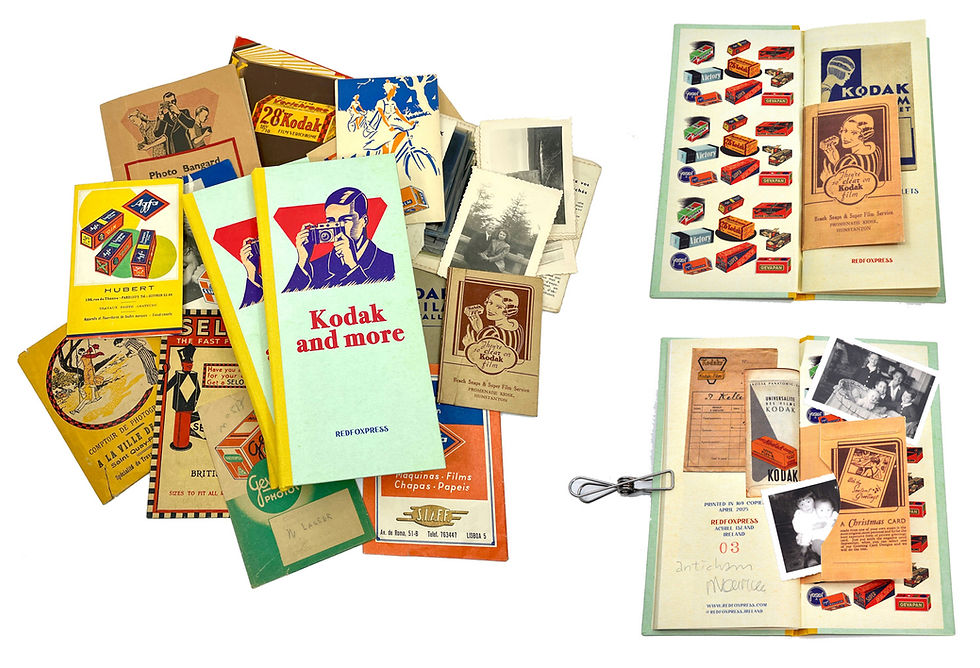
Alongside collecting old photographs, we also gather photography-related ephemera to create limited edition publications. One such project is Photobooth Time, a book combining our own portraits taken in photo booths across various cities with vintage photobooth images. Another book is Kodak and More, a book focused on the promotional designs printed on film wallets used by photo labs from the 1930s to the 1970s to return negatives and prints to customers. This collection highlights the graphic design and branding of film companies from that era.
BOOKS ARE AVAILABLE ON
https://www.redfoxpress.com/new.html
@redfoxpress.ireland, @antic_ham
All images are ©REDFOXPRESS
Void

@Olivia Arthur
© András Ladocsi, There is a Big River, in Which There is a Big Island, in Which There is a Lake, in Which There Is an Island, in Which There Is a Small House, Where a Life Is Growing in a Womb

© Yoshi Kametani

© Tony Dočekal

© Tony Dočekal
© Void, all rights reserved
Murmurings of the Skin by Olivia Arthur
Void is continually drawn to stories that begin with the personal—where a single voice becomes the entry point to something vast and collective. Murmurings of the Skin is a good example of this. What begins as Olivia Arthur’s quiet contemplation of her own body during pregnancy gently unfolds into a complex, layered meditation on touch, intimacy, and what it means to be human in an age of machines and distance.
There is something deeply resonant in the way the work moves—from the private space of skin to global stories of contact, care, and disconnection. From Mumbai to Rome, from a ballerina with prosthetic limbs, to machines designed to replicate gestures of love—each element echoes a shared vulnerability. The body becomes not only a subject but a landscape, a threshold, a question.
In shaping the book, we chose to honour that murmur — never overpowering the narrative, but letting it breathe. The design holds the images in quiet rhythm, allowing the reader to move through layers, pauses, and contradictions, much like the body itself navigating time. Small handwriting notes from Olivia adds a further poetic tone to it. The result is a book that invites touch as much as it invites thought; a tactile object that reflects on flesh, memory, technology, and fragility, without offering simple answers.
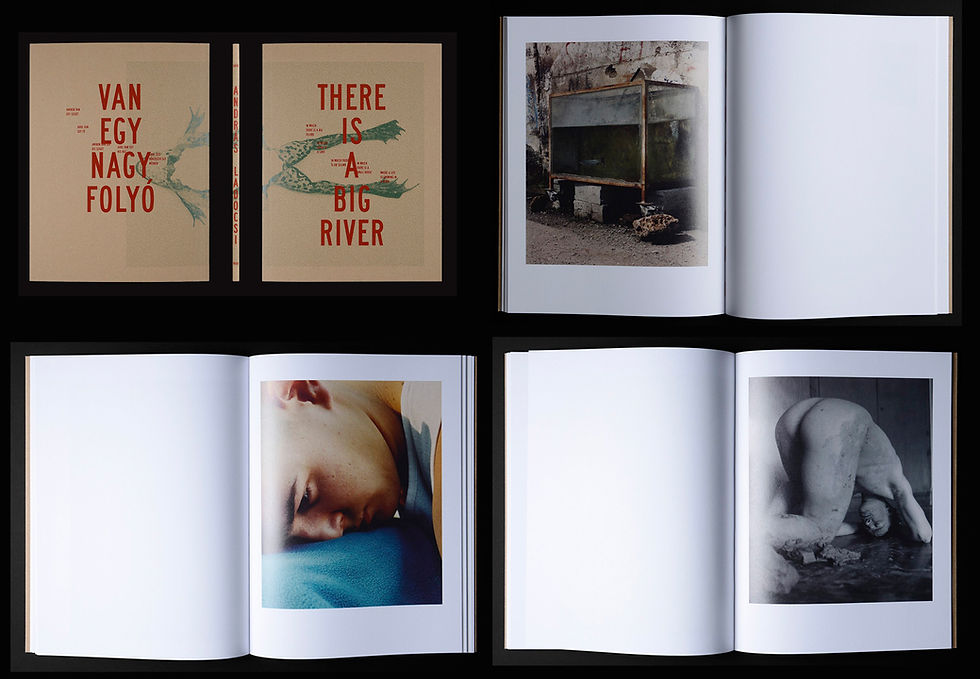
There is a Big River, in Which There is a Big Island, in Which There is a Lake, in Which There Is an Island, in Which There Is a Small House, Where a Life Is Growing in a Womb by András Ladocsi
The agency over our own body versus government control.
The epic title—There is a Big River, in Which There is a Big Island, in Which There is a Lake, in Which There Is an Island, in Which There Is a Small House, Where a Life Is Growing in a Womb—is both literal and metaphorical. It traces nested geographies and nested selves: homeland, community, body, womb. András emerged from that generational anxiety (common among Hungarian men) towards emotions, towards expression. As he puts it, “I want to change this” by celebrating skin, body, friendship, trust, life—with all its ups and downs.
András builds intimacy through slow encounters. He hunts light, waits in frozen lakes, invites friends and strangers alike into water, into space, into embodied trust. These are not staged performances, but organic connections, vulnerable bodies in relational spaces.
At first glance, the book’s language is simple: about 50 images, no text save the title. But its photographic expression is layered and profound. Each image stands alone and yet resonates with collective memory, song, ritual, and resistance. The design is humble in format (silkscreened softcover, 24×32 cm, 88 pages) but rich in pacing and spread rhythm.
In this context, the body is not just a subject—it’s a geography of freedom, rebellion, and connection. Through these layered photographs, András threads a narrative of personal and political emancipation, reminding us that under control, we can still feel, we can still flow—and find within us, islands of resistance and life.
In sum, the poetic and personal expanding to the universal is what draws most of Void’s interest in the project.
I’ll Be Late by Yoshi Kametani
Void was drawn to I’ll Be Late not only for its diaristic intimacy, but for how it uses the personal as a portal into deeper existential terrain. The project begins in the thick of lived experience—fragments of daily life, banalities, moments of friction and affection—and gradually unfolds into a broader meditation on time, existence, and image-making itself.
At its core, the book is a philosophical gesture masquerading as a visual journal. Kametani’s images—saturated, layered, often elusive—don’t seek resolution. They loop, echo, contradict. Repetition becomes a formal strategy: scenes recur, gestures repeat, ideas drift and resurface in altered states. The design and editing embraced this rhythm, choosing a structure that lets the reader swim in the flux, rather than follow a linear path.
The book plays with redundancy not as a flaw, but as a poetic device. Through it, the act of seeing becomes recursive. One doesn't merely observe time passing, but senses how memory works—circling back, re-editing, overwriting. What may seem random at first begins to feel intentional, almost inevitable. As though the images themselves are trying to tell you they are tired of being just images. This mimics the gesture of the screenprint that Yoshi did to generate the final images for the book.
Void edit the book to hold this contradiction—simple in form, generous in space, yet complex in sequencing. It’s a work that resists certainty and encourages re-reading.
The Color of Money and Trees by Tony Dočekal
Void recognises in Tony Dočekal’s The Color of Money and Trees a quiet, sustained dialogue between photographer and subject that unfolds over years, evolving beyond simple documentation into something more intimate and fluid. The work blurs the line between documentary and diary, capturing not just moments but moods, histories, and shifting relationships.
Tony revisits familiar faces and places again and again, allowing time and memory to soften edges and deepen meaning. The images live somewhere between observation and confession—where distance meets closeness, and truth mingles with interpretation. This balance is at the heart of the project’s compelling tension.
Void’s edit and design reflects this layered process: the book breathes in measured rhythms, folding archival fragments, portraits, and snapshots into a nonlinear narrative that feels both private and universal. Intertwining the texts with grids of US cityscapes. The book invites the reader to experience Tony’s story as a witness and also a colleague.
PhotoBook Journal
It's been over three years since I queried Douglas Stockdale about including PhotoBook Journal book reviews as part of the showcases. That first one, Photographers and Text, seemed like a perfect fit - and since then we've included almost sixty reviews. For this showcase, I wanted to pull back the curtain and give you a bit of insight into the Journal, their team of contributing editors - how they approach their reviews and links to their own work as well as a recent photobook review for the Journal.
The reviews are on a separate page, use this link.
