Thinking About Photography
Dedicated to expanding our ideas about photography
PhotoBook Journal
As always, I am very grateful to PhotoBook Journal with selections from editor Hans Hickerson and their team of Contributing Editors on books exploring the many facets of Portraiture. I encourage you to use the links to read the full versions of their thoughtful reviews.
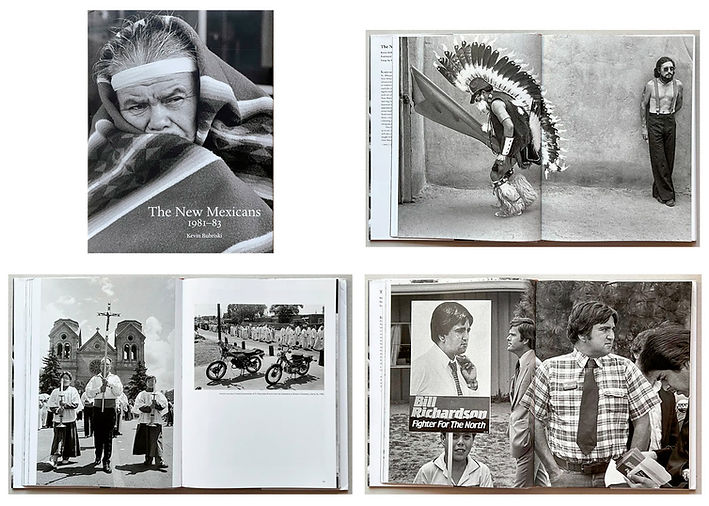
© Kevin Bubriski
The New Mexicans, 1981-83 by Kevin Bubriski
Publisher: Museum of New Mexico Press; © 2024
Review by Gerhard Clausing
Kevin Bubriski has long been recognized for his special ability to document various groups and communities with sensitivity and respect, from Nepal to the American heartland. In The New Mexicans, his attentive look is focused on the people and landscapes of New Mexico, capturing the early 1980s in a photographic narrative that interweaves heritage and contemporary concerns.
This photobook presents portraits and activities of individuals who embody the cultural depth of New Mexico’s history – Native American, Hispanic, and Anglo communities as they are intersecting and coexisting across generations. We are able to witness folks in ancient ceremonial celebrations as well as in contemporary religious events and practices. We acquire an appreciation of the impact of the landscape on outsiders who wish to meditate and contemplate, among them the “flockers.” Contemporary culture has entered the realm of the descendants of the original inhabitants, and they have become participants in a society with multiple roots and backgrounds, and with concerns about contemporary politics. Some of the images show the entertainment industry and members of the art world in the process of telling stories with new perspectives... Use this link to read the rest of the review, additional images and information

© Kevin Cooley
The Wizard of Awe by Kevin Cooley
Publisher: The Eriskay Connection, Netherlands, © 2024
Review by Hans Hickerson
Wow. There is a lot to like about Kevin Cooley’s The Wizard of Awe. A happy marriage of book design, storytelling, and photography, it elevates the photobook conversation to a level higher than anything I have seen in a long time.
For starters the cover is spectacular. It shows falling smoke and embers from an explosion rendered in black silk screen printing and copper foil embossing that pops off the page.
It only gets better when you open the book. Colored paper is used as one way to denote chapters or sections, and six pages of uncoated orange stock open and close the book. After the title page, emails to the author from Ken Miller, the “Wizard of Awe,” start the narrative. Then we see four dark full-page photographs of fire and smoke, one to a page spread, with a blank black page opposite. The nighttime lighting is dramatic and the coiling smoke becomes a menacing creature conjured by a Harry Potter villain. ... Use this link to read the rest of the review, additional images and information

© Amy Horowitz, 2025
A Walk in the Park? by Amy Horowitz
Publisher: Schilt Publishing & Gallery, Amsterdam, ©2025
Review by Lee Halvorsen
Amy Horowitz takes us for A Walk in the Park and magically transports the reader into the stories of those she’s photographing. Washington Square Park and the West Village in New York City are rich with diversity and young people discovering themselves and adulthood in today’s world. Horowitz brings us face-to-face with their emotions and gives us a hint of their fears, their wonder, their confidence and a peek into what they might one day become.
This street photography book is an artistic work of human portraiture, more than the technical quality of the images (which are very high), more than the variety of outward appearances (or armor, Horwitz says), more than a fleeting click of the shutter. The images tell of a human connection between Horowitz and the subject captured in the moment by her camera. But why are these different than most?
“Whatever you do, don’t smile,” is Horowitz’s prompt when making images with her subjects. Her IG address is @dont_smile_nyc. I think this creates a unique dynamic ... Use this link to read the rest of the review, additional images and information

© Loli Kantor
Call Me Lola by Loli Kantor
Publisher: Hatje Cantz, Berlin Germany, © 2024
Review by Steve Harp
It takes time for what has been erased to resurface.
-
Patrick Modiano, Dora Bruder
Loli Kantor’s Call Me Lola: In Search of Mother has been obstinately staring at me from my desktop for some weeks now. At each encounter, I would fitfully and clumsily try to find a way into thinking about this book, a way to do justice to the story, the images, the unsettling hauntingness of this volume that, although offered as a photography book, I can only think of as something else entirely – a memoir, a detective story, a search for a mother never known who died scant hours after the photographer/memoirist/detective’s birth. The difficulty this reviewer has encountered in finding a way into writing about this tragic yet compelling story can only suggest in the most minimal way the journey of the photographer in her pursuit of finding her mother.
Hovering over my encounter with this book has been the ghost of Dora Bruder, a short work published in 1997 by Nobel Prize winner Patrick Modiano. Dora Bruder tells the story of his search, prompted by a short notice found in a 1941 copy of Paris-Soir:
Missing, a young girl, Dora Bruder, age 15, height 1 m. 55, oval-shaped face, gray-brown eyes, gray sports jacket, maroon pullover, navy blue skirt and hat, brown gym shoes... Use this link to read the rest of the review, additional images and information

© Nadia Sablin
Years Like Water by Nadia Sablin
Publisher: Dewi Lewis, UK © 2023
Review by Hans Hickerson
Spending extended time somewhere, getting to know the locals, participating in the community and earning its trust is a tried-and-true approach to completing a photography project and turning it into a book. Nadia Sablin’s Years Like Water is a particularly successful example of this. Like similar books, hers connects us with and helps us understand a place and people. Because of Sablin’s unusually close relationship with her subjects, however, it transcends mere document status and offers an unforgettable tableau of the human condition.
Sablin photographed in the village of Alekhovshchina, Russia, from 2008 through 2021. She had spent childhood summers there until she left for the U.S. when she was twelve, and her family was known in the community. For her project she typically went back in the summer and photographed, but in 2018 a Gugenheim fellowship allowed her to stay for the year. Use this link to read the rest of the review, additional images and information

© Alan Wieder, 2025
We Will Not Be Removed: The People of King School Park, by Alan Wieder
Publisher: Oregon Cultural Heritage Commission
Review by Lee Halvorsen
Wieder’s intimate images and skilled story telling brings persistence, permanence, place, and people to life in Portland’s King School Park. Wieder spent several years photographing folks in the Park, people who return almost daily despite the tsunamis of neighborhood change over the years. Mitchell Jackson grew up in the community; his foreword provides historic and social context for a community that started as a Black neighborhood, veered into a troubled “hood,” and is now in a gentrification phase. Through all the years, all the changes, and all the generations, many people who grew up in the neighborhood still return, even if they’ve moved miles away. And some original residents remain. But that’s the wonder, it’s the Park that draws them back, gives them a sense of belonging, and makes conversation and relation the priorities. Where everyone knows your name.
Jackson’s foreword gives us a sense of community, of joy, anguish, smiles and smudges…this is a real place, with real people who want to stay connected despite miles and time…and the Park, well, the Park is the place where that magic happens. Use this link to read the rest of the review, additional images and information