Thinking About Photography
Dedicated to expanding our ideas about photography
The Stories We Tell
Fall 2026
October 23rd - November 20th


“Tell me a story” is a human instinct. We have been telling and listening to stories since our beginning (for which we literally have an origin story). This need to tell and hear stories helps us make sense of our lives and the world around us. The stories we tell ourselves and others give us a structure, a tool with which to understand ourselves, others and the cultures we live in. What is photography’s role in this? Verification, illustration, and exploration. Verification is in flux; we might be the last generation to think of photography as truth. Illustration is “This is what my story looks like or this is how it could be.” Exploration asks "What else could be real, and what would we want that to look like?"
Many of the artists in this showcase are coming from very personal spaces, using photography to connect with those who have come before us, and with what has been lost. Family plays a big part in many of these projects, often as a base camp from which to explore larger cultural experiences. Finally, there are multiple projects that explore how we gain power and identity through the face we offer the outside world.
This is the third of four Conversations Across the Archives exploring the intersections between the artists I’ve featured over the past five years. I am pulling from a wide range of showcases: Resistance, How We Live, That Which is Absent, Identity, Family, Community, Experimental and Home. You will find a link to the original showcase at the end of each artist's statement.
Mercedes Dorame


© Mercedes Dorame, all rights reserved
Living Proof
It is a strange experience, touching the walls of your apartment with the eyes of your grandmother. I found that memories play an allusive game with the mind. They are tucked away, buried, hidden, almost forgotten until light, patterns, and objects trigger the drawer where they reside to slowly slide open. Suddenly your home is their home, generations collide, and memories cross paths, melding into one existence. These images are the result of that collision. I made memories from photographs, photographs from memories. I've watched ideas turn into substance, flesh into skin tone, light into being.
This body of work emerged from a need to piece together a past that felt like it was slipping from my grasp. It was born from my experiences of feeling powerless as Tongva burial sites were disassembled and my ancestors were removed from their resting places. As a Tongva tribal member, I have observed and consulted on culturally sensitive archaeological sites in Los Angeles and Orange County. At times this entails examining cultural belongings (artifacts). However, more frequently I am encountering burial sites that have great emotional and spiritual significance.
The picture that forms is of a Native American family that does not have reservation lands to call home. The family members do not fit Edward S. Curtis's stereotype of the "vanishing race." They lived their entire lives in a city that tried to erase their culture, a city that was once their tribal land. They became and always were and will be the population of Los Angeles.
The exploration and research for this work began with a gift from my father, an archive of unfamiliar photographs that had been resurrected from old boxes in albums. It was exhilarating to see my family as I did not know them: on their wedding day, as young parents, in formal family portraits, and on the beaches of Santa Monica, where I myself spent so much time growing up. By combining these photographs with the intimate space of my home at the time, I worked to re-assign missing contexts and to reintroduce my family into my contemporary existence.
The Tongva are Always Present - Honuukvetemme’ Woont ‘Ekwaa
We are Future Generations - Toomshar ‘Eyootaarxen
Mercedes's work was originally featured in the Resistance Showcase - use this link to see the rest of that showcase
Federico Gama
©Federico Gama
©Federico Gama

©Federico Gama

©Federico Gama

©Federico Gama

©Federico Gama,
© Federico Gama, all rights reserved
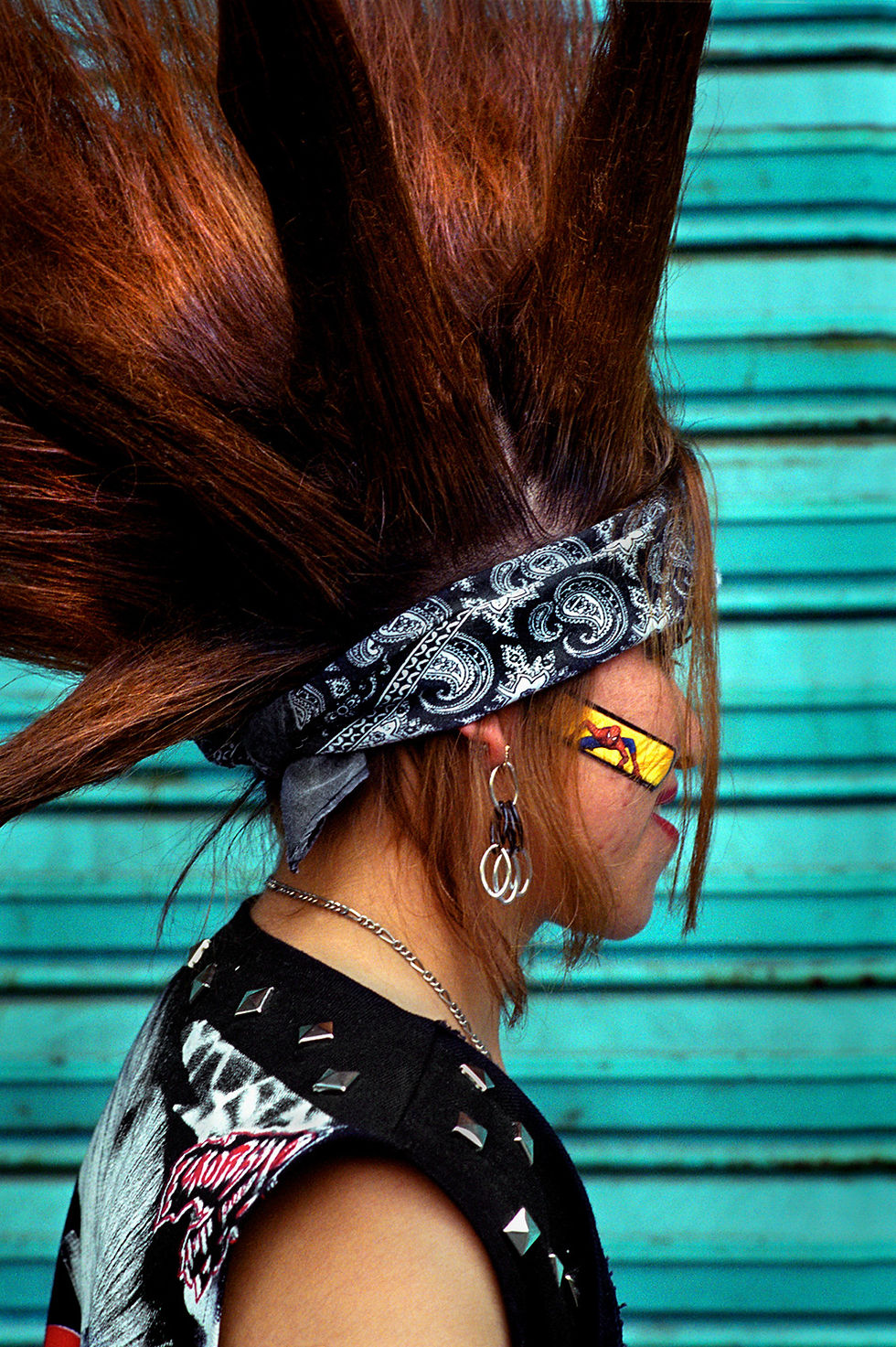
TOP MODELS MAZAHUACHOLO-SKATOPUNK
Since culture has existed, human beings have not only dressed out of necessity: clothing defines us, identifies us, highlights us, integrates us, marginalizes us, distinguishes us, exposes us, conceals us, situates us, empowers us. In other words, it is loaded with signs, meanings, and symbols; it is a means of expression, both personal and group, conscious and unconscious.
In this project, I address the issue of discrimination and how young people of indigenous origin, construction workers, and domestic workers, faced it in Mexico City.
One of the things that interested me was seeing how they moved, confidently and defiantly, when they walked the streets in their fantastic outfits, and I wanted to capture precisely what they reflected, feeling urban in their own right, something unprecedented among these groups.
The look as an act of invisibility and rebellion at the same time, ceasing to be indigenous and enjoying the city with a countercultural appearance. The construction of their clothing as a way of reinventing themselves every weekend.
It was an opportunity to document body language. This idea allowed me to portray the young Mazahuacho-skatopunks as attractive characters in the city and to expose the confidence that the power of an outfit gives them.
Federico's work was originally featured in the How We Live Showcase - use this link to see the rest of that showcase
Soomin Ham

© Soomin Ham
© Soomin Ham

© Soomin Ham

© Soomin Ham

© Soomin Ham

© Soomin Ham
© Soomin Ham, all rights reserved
Sound of Butterfly
Sound of Butterfly presents an experimental yet personal approach to understanding and loss, grief, and memories through my mother's journey. Butterflies were one of my mother’s favorite things, but to me, they also symbolize a new journey. Sound of Butterfly is presented in the photographic series: Back to Heaven, Frozen Moment, and Memory of Ashes.
After the tragic loss of my mother, I began collecting memories and belongings that she left behind. To cherish my mother's life, I created my first series titled Back to Heaven, which is also the name of her favorite Korean poem that reflects on the fleeting nature of life, moments of joy, and happiness. The series consists of 12 reproductions of old family photos featuring soft, blurry images of photographs of my mother.
To create this series, I re-photographed a selection of photos from family albums, including portraits of my mother, vacations, weddings, and group portraits, and printed them on rice paper. The rice papers were then submerged in water, washed, and dried repeatedly until the images grew dim. Finally, the prints were placed outside during snowfall and photographed again, capturing the moment when the images began disappearing under the
fallen snow.
This entire process became a visual metaphor that helped me not only gain a deeper understanding of the cycle of life and fading memories but also embrace my grief by tracing the path of my mother’s life.
Soomin's work was originally featured in the That Which is Absent Showcase - use this link to see the rest of that showcase
Jung S Kim
© Jung S Kim


© Jung S Kim

© Jung S Kim

© Jung S Kim

© Jung S Kim
© Jung S Kim, all rights reserved
Circle II
Circle II: Identical illusion is a masquerading self-portrait series in search of flawless raw “I” and core identity that delves into my personal journey, drawing inspiration from the complexities of my upbringing and the cultural tapestry that has woven through my experiences.
In the midst of my childhood marked by my parents' divorce, I navigated through the stormy seas of uncertainty, moving from one relative's home to another. This period became a framework through which I observed the application of power dynamics and the contradictions inherent in Confucian values in Korean society. Among these turbulent times, the most profound experience was living with my aunt, a Korean shaman. During the five years of cohabitation with my shaman aunt, the influence of shamanistic Buddhist art stimulated my artistic sensibility and creativity, later becoming a significant motif in the whole Circle series as well as Circle II series. This interplay of personal experiences and cultural critique has molded the series into an exploration of self and a broader societal commentary. A shocking encounter left a lasting imprint on my soul, compelling me to reconstruct these early experiences through photography. This artistic endeavor became a means to transcend personal trauma and delve into the layers of my identity. Drawing inspiration from Korean folk art and props, my work exposes distorted and layered personas shaped by cultural norms and societal boundaries.
The Circle II series is a journey to meet the unadorned, complete, and pure ‘I.’ This series was motivated from the Korean didactic tales and legends, which is "The wicked fall and the good prosper". I replaced different fictional characters in the folklores with myself. The personalities of the characters are reinterpreted from a subjective point of view. So their personalities are intentionally twisted and exaggerated by unnatural beatification, despising caricaturing, maximization of extreme fear and complete identifying. Through the methodology of my disguised self-portrait, I aim to achieve gender equality within myself through the fluid exchange of male and female characters, embodying my belief in bisexuality for everyone. Traditional barriers that glorify good and punish evil within myself collapse, and the obsessive belief in patience as a virtue becomes obsolete.
In essence, Circle II strives to find a delicate balance between personal narrative and cultural critique. By intertwining the threads of my own experiences with the broader societal challenges, the series leads me with confidence from imagination to reality. Thus, this series is a form of self - meditation to obtain equilibrium of my soul, as well as a personal diary of the process from immaturity to maturity.
Jung's work was originally featured in the Photographers and Identity Showcase - use this link to see the rest of that showcase
Linda Plaisted
© Linda Plaisted

© Linda Plaisted

© Linda Plaisted

© Linda Plaisted

© Linda Plaisted

© Linda Plaisted
© Linda Plaisted, all rights reserved
How the Light Gets In
I use my art practice as a therapeutic form of self-expression and create every day as a visual journal of my life and a response to the cultural zeitgeist. Experimentation is a voyage of discovery for me; a way of finding meaning through the process of play and practice. I think my willingness to show up, try new things and fail on a daily basis is what allows me so much space to flow into whatever comes next. I think Picasso said, "Inspiration exists, but it has to find you working." No wild tangent is off the table as long as it stays true to my overarching mission statement- to be a champion of women and mother Earth.
I created my series How The Light Gets In in response to a good friend's terminal cancer diagnosis, which landed like a grenade amid the constant bombardment of dark and disturbing imagery we have all been subject to over the past several years. Shattered, I was looking for a way to express my own grief and society's collective despair while also searching for some small pinpoint of light in a dark time.
I heard an old Leonard Cohen song one day and his words inspired creative experimentation.
"The birds they sang
At the break of day
Start againI heard them say
Don't dwell on what has passed away
Or what is yet to be
Ah, the wars they will be fought again
The holy dove, she will be caught again
Bought and sold, and bought again
The dove is never free
Ring the bells that still can ring
Forget your perfect offering
There is a crack, a crack in everything
That's how the light gets in"
Ancient peoples once believed that the stars were holes in the sky where departed loved ones looked down on us from above; eyes shining. Knowing that my friend would soon be among those stars, I found great comfort in this simple idea. Layering my original photography, vintage found photos and collected paper ephemera, I then applied a hand-painted dot pattern on top of the natural elements to represent the tiny cracks in everything where light and love can get in and shine out. In this series, the trees and animals represent our eternal connection to the natural world, while the distressed paper scraps- the fragile and fleeting passing away of all things. I am in the studio now further collaging these finished prints onto cradled birch panels after (quite literally) painstakingly poking each image full of hundreds of tiny holes, then finishing the mixed media pieces with paint, encaustic and cold wax medium. It's a multi-step, multi-disciplinary process that synthesizes my studies in photography, fine art, psychology and mythology to alchemize dark materials into light. There is nothing perfect about the work- but this experimentation is my offering to my now-departed friend and to the weary, wounded world.
Linda's work was originally featured in the Experimental Showcase - use this link to see the rest of that showcase
Fan Shi San

© Fan Shi San

© Fan Shi San
© Fan Shi San

© Fan Shi San

© Fan Shi San

© Fan Shi San
© Fan Shi San all rights reserved
Two of Us
I made the Two of Us Portraits project between 2009-2013, photograph people who grew up as only child in China with an imaginary sibling, all only child as a result of the strict 30 years of One-Child Policy of 1980-2010. The policy is enforced at provincial level through fines and other punishments, leaving a result of over 100 million only child in China.
The One-Child Policy in China restricts the number of children a married urban couple can have to one. In fact, nearly every Chinese born after 1980 in urban, including myself, is only child with no siblings.
The absence of siblings left deep imprint on One-Child generation's identity, The loneliest generation in China history are searching for something more meaningful to connect with others.
Beside the Rusticated Youth of China, and the Culture Revolution, the only child generation was the nation’s most turmoil in post-Mao China, but it is more personal and internal. To me, the imaginary of Two of Us is much true than today‘s reality, the progress of shooting Two of Us is a ceremony, to record the tragedy history of One-Child into memories.
Fan Shi San's work was originally featured in the Family Showcase - use this link to see the rest of that showcase
Amanda Smith

© Amanda Smith

© Amanda Smith
© Amanda Smith

© Amanda Smith

© Amanda Smith

© Amanda Smith
© Amanda Smith, all rights reserved
Keeper of Secrets
We all keep secrets. Some dark, but most are petty and maybe a little foolish. Contrary to accepted opinion, men are more likely to divulge secrets than women. We tend to hold our secrets pretty close. Especially those little, quirky, benign ones.
In this body of work I am not attempting to betray those secrets. I am representing the keepers of secrets, not the secrets themselves, by hiding parts of us away. The secrets reside in the land of our dreams, coexisting side by side, mingling and reproducing, creating ever more opportunities for me to imagine and discover.
Amanda's work was originally featured in the Community Showcase - use this link to see the rest of that showcase
Rashod Taylor
© Rashod Taylor

© Rashod Taylor

© Rashod Taylor

© Rashod Taylor

© Rashod Taylor

© Rashod Taylor
© Rashod Taylor, all rights reserved
Little Black Boy
My work addresses themes of race, culture, family, and Legacy and these images are a kind of family album, filled with friends and family, birthdays, vacations, and everyday life. At the same time, these images tell you more than my family story; they’re a window onto the Black American experience. As I document my son I am interested in examining his childhood and the world he navigates. At the same time these images show my own unspoken anxiety and fragility as it pertains to the wellbeing of my son and fatherhood. At times I worry if he will be ok as he goes to school or as he plays outside with friends as children do. These feelings are enhanced due to the realities of growing up black in America. He can't live a carefree childhood as he deserves; there is a weight that comes with his blackness, a weight that he is not ready to bear. It's my job to bear this weight as I am accustomed to the sorrows and responsibility it brings, the weight of injustice, prejudices, and racism that has been interwoven in our society and institutional systems for hundreds of years. I help him through this journey of childhood as I hope one day this weight will be lifted.
Rashod's work was originally featured in the Home Showcase - use this link to see the rest of that showcase
The Handmade Photograph Showcase